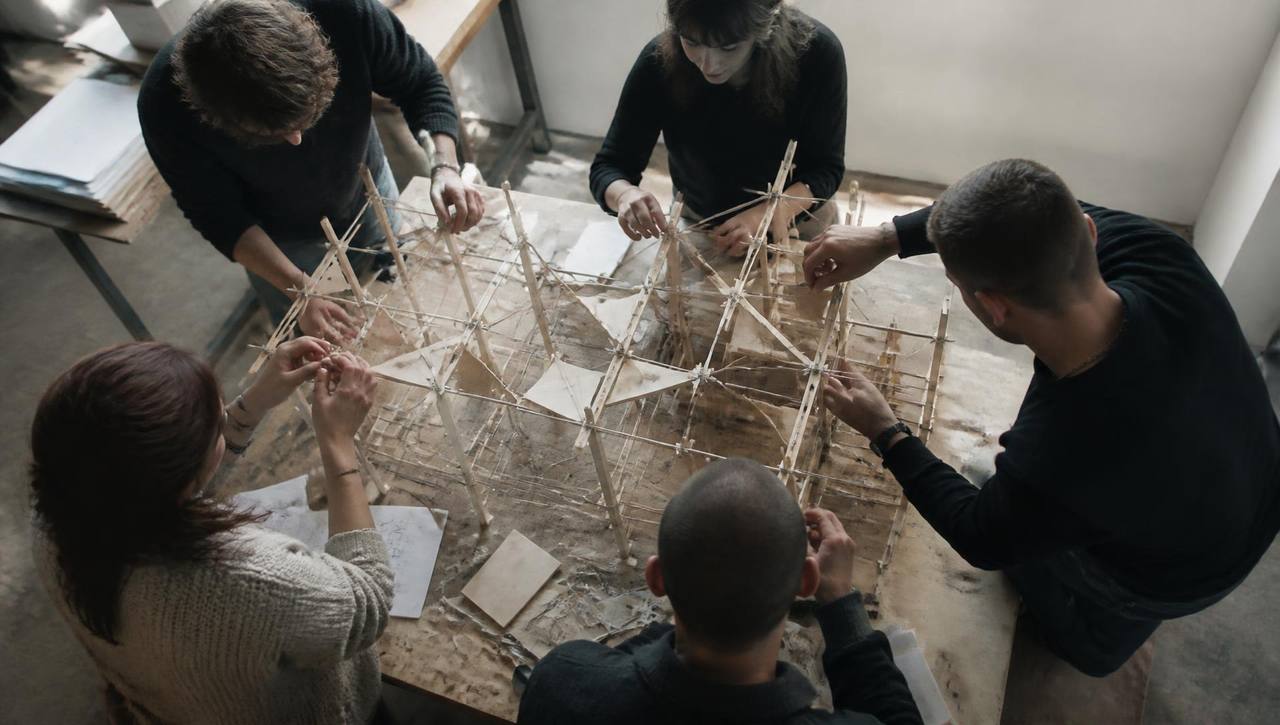
Collaboration Is a System, Not a Soft Skill
Trust matters. So do purpose, information flow, governance, collective intelligence, coordination and the way the whole system fits together.
ROCeteer · 2 min read

The soft-skill frame is too small
Collaboration is often placed beside communication, empathy and teamwork in a list of interpersonal capabilities. That framing makes it easy to believe that collaboration improves mainly by training people to behave better.
Individual capability matters, but collaboration is an emergent property of a system. People can be skilled, generous and well intentioned and still fail to collaborate when goals conflict, information is withheld, incentives pull in different directions, authority is unclear or nobody owns the dependencies between organisations.
Six conditions work together
ROCeteer thinks about collaboration as a stack of interconnected conditions: Purpose & Identity, Human Conditions, Relationships & Communication, Collective Intelligence, Collaborative Governance, and Coordination & Action. Digital tools, data and AI sit underneath as enabling infrastructure.
None of these elements is sufficient on its own. Collaboration quality emerges from the relationships between them. That is why a new platform rarely fixes a trust problem, and a team-building exercise rarely fixes confused decision rights.
Failure patterns are diagnostic clues
The most useful question is often not “What is wrong with these people?” but “What pattern is this system producing?” Strong purpose with weak governance produces agreement without decisions. High trust with poor coordination produces enjoyable meetings and inconsistent delivery. High diversity with low psychological safety produces representation without contribution. Strong action with weak learning produces activity without adaptation.
Seeing patterns this way depersonalises the problem and opens more useful design choices.
“When collaboration underperforms, the problem is often in the system between people — not in the people themselves.”
ROCeteer
Diagnose before prescribing
Because collaboration is systemic, interventions should start with diagnosis. Where is value being lost? Which boundaries matter? What are participants optimising for? What is hard to say? Who can decide? Which commitments routinely break? What information arrives too late?
Different answers require different interventions. Sometimes the leverage is a conversation. Sometimes it is a new governance mechanism. Sometimes it is a shared metric, a redesigned process, a neutral facilitator, a platform, an incentive or a completely different set of participants.
Capability means learning to see the system
The practical skill is not just being collaborative. It is learning to see collaboration: recognising interdependence, diagnosing the conditions, designing the interfaces and adjusting the system as people learn.
That is why collaboration can be taught, assessed and improved. It is human, but it is not vague. It is relational, but it is not accidental. And once leaders see it as a system, they gain far more levers than “communicate more.”