Human x AI x Human: The Workshop Is Changing
AI can make a room of people more collectively intelligent - without replacing what makes the room human.
ROCeteer · 2 min read
Workshops Lose Information
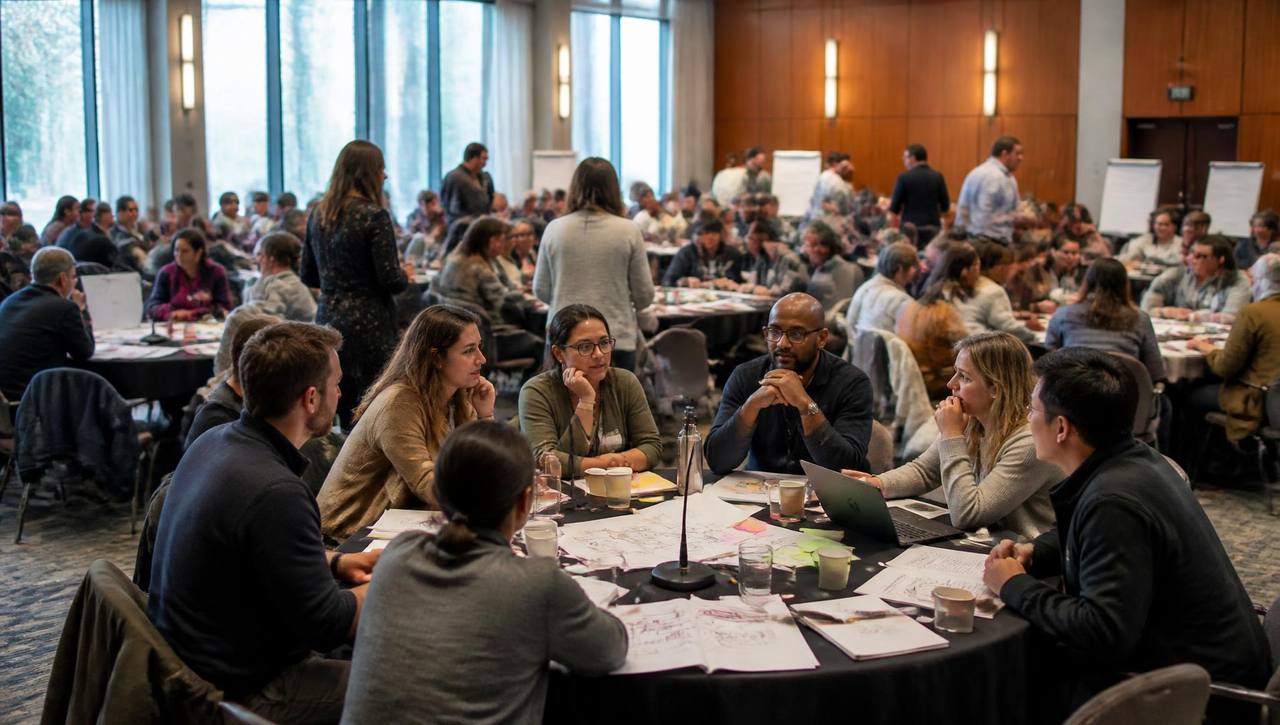
Put one hundred people into ten roundtable conversations and an extraordinary amount of information appears. Stories, examples, tensions, minority views, unexpected connections and practical ideas emerge simultaneously. Traditional facilitation captures only a fraction. A few notes reach a plenary. A handful of themes make it onto a wall. Much of the room's intelligence disappears as soon as people leave.
This is not a failure of facilitators. It is an information-processing problem. Human attention is limited, and large-group collaboration produces more conversational data than a small facilitation team can absorb in real time.
AI Can Listen Across the Room
With appropriate consent, privacy controls and careful handling of transcripts, AI can help process that volume. Conversations can be transcribed, stripped of unnecessary attribution and analysed for themes, points of divergence, recurring barriers, unusual ideas and relationships between topics appearing at different tables.
This changes the scale at which a workshop can listen to itself. Instead of only hearing the table spokesperson or the most confident plenary voices, the organisers can examine patterns across a much broader set of contributions.
The technology is not the value by itself. The value comes from what the group can notice because the information becomes visible.
AI Becomes a Collective Mirror
The most useful metaphor may be a mirror. AI does not need to tell the room what the answer is. It can reflect back what the room is saying.
"Six tables independently raised procurement as a barrier." "Three groups described the same trust problem using different language." "Most participants agree on the destination but disagree about who should act first." "One minority idea appeared only twice but connects two challenges that were otherwise treated separately."
Those observations can become prompts for the next round of human conversation. The group sees itself more clearly and can decide what deserves attention.
“AI does not need to replace the facilitator. It can help the room hear itself.”
ROCeteer
Humans Still Decide What Matters
AI can cluster language and identify patterns, but workshop sensemaking involves context, ethics, emotion, power and lived experience. A model may identify that two ideas are semantically similar while missing why their political implications are completely different. It can summarise disagreement without knowing which stakeholder carries the consequences.
Human facilitators and participants therefore remain responsible for judgement. They decide whether a pattern is meaningful, whether a minority voice needs protection, whether a conclusion is sufficiently grounded and what action is legitimate.
AI can increase the resolution of the collective picture. Humans remain accountable for what the picture means.
Design the Intelligence Loop
The exciting design is iterative: Human conversation -> AI synthesis -> Human sensemaking -> Better human conversation.
A workshop might run a first round, synthesise themes across tables, project the synthesis back to participants, invite challenge and correction, then use the revised understanding to shape a second round. The AI is not outside the collaboration. It becomes part of the feedback loop.
Done well, Human x AI x Human can help a room become more collectively aware without making the experience less human. The technology disappears into the collaboration design, while more of the human intelligence becomes usable.